We are offering computer classes for … Beyond the code 6th-12th grades. STEM classes focused on technology including digital forensics, cyber security, IoT, and Linux.
Why Can’t I Get My Kids to Behave?
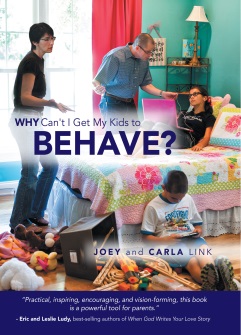
I have just finished reading the book Why Can’t I Get My Kids to Behave? authored by Joey and Carla Link. How encouraging and convicting! Do you have a PLAN for raising responsible, respectful, and obedient children whose lives are a shining example of Christ? Even with a plan, it is SO EASY to become weary! This book helps a parent to set Godly standards and lays out the steps to training obedience. Is it possible to raise obedient children? Yes. IF we do not give up in our weariness (Gal. 6:9)
One clearly made point to me was about time-outs, grounding, and taking away privileges. The Links say that these parenting practices are often not effective because the child is just serving their time much like a prison sentence. I can clearly see my children just wait for the time to be up and it’s not long before they are returning to the same behaviors! This book provides answers to such a dilemma.
There are so many examples and practical applications that this book provides. It is a must read and a great addition to your Christmas list!!
The authors and their adult children are very dear friends. The fruit of their labor as parents is beautiful. I am not alone with my opinion of this book. As of today there are 43 reviews of this book on Amazon and ALL of the reviews are five stars and I haven’t even added my review yet! I encourage you to check out the Link’s website titled Parenting Made Practical.
A typical day using STEPS
What does your typical day look like using STEPS (Sequential Teaching of Explicit Phonics and Spelling)?
I was recently asked this question during a parent conference. Now here’s the context…
I have been teaching the STEPS program (similar to the SWR program) in my homeschool co-op since September 2012. We meet only once a week for 50 minutes. I have had to modify many things to fit this abbreviated schedule so no I have not followed either program as it was “designed.” Yet the results are still there!
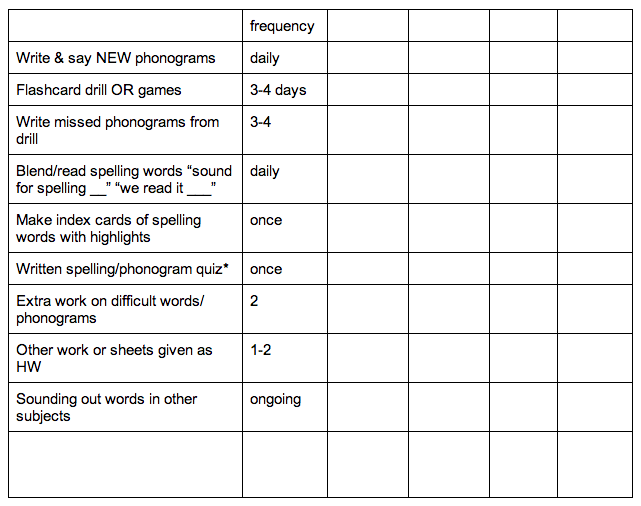
It was during a conference that a parent stated (something to the effect of) for this program to really work, it is obvious there needs to be more work done at home than what I assign. I was then asked if I could make a checklist of the work we do in a week. I am posting the checklist here to help others also. Some of the items may need to be crossed off if you haven’t gotten to that point (like spelling words) while other items can be added.
Download a printable copy of the above chart from Google Docs
Memorizing Vs. Analyzing Spelling Words
The main difference between STEPS/SWR and other curriculum is that the child is trained to use the knowledge of the sounds and letters (called phonograms) to spell words. He learns to spell a word based on the phonograms he hears PLUS applying the spelling rules. He has to make decisions on which phonograms to use and then analyze why a word is spelled the way it is (with highlights). Most reading programs use a memorization method often with no rhyme or reason on why a word is spelled or read a certain way (and the child “brain dumps” the information after the spelling quiz!)
One of the best methods to learn spelling words is to practice “sounding them for spelling” and to blend the sounds together to “read it”. We talk about the red highlights and how they make the word sound. We discuss the spelling rules that apply to the words. I have made a short video of my 5 year old son practicing his spelling words because a picture truly is worth a thousand words!
A video of Josiah sounding for spelling and reading:
Notice that the focus is on the sounds the letters make rather than the letter names. When you are trying to read and spell a word, knowing the sounds to automatic is a must because most letters (consonants) do not say their name. For example, the letter B never says “b” in a word! So rather than focusing on spelling “bed” by saying the letter names b-e-d, the child should focus instead on the sounds /b/-/e/-/d/. When a child can spell “bed” rest assured he can read it also!
How to Teach Your Child to Read Part 2
Podcast: Play in new window | Download
Subscribe: Apple Podcasts | RSS
 Teach your kindergardener to read at a 3rd grade level before they enter 1st grade. It is not only possible it is achievable. In this episode you will get some tips on how Sherry homeschooled our kindergardener. The key is focusing on what matters.
Things mentioned in this episode:
How to Teach a Child to Read Part 1
Interview with Elizabeth (Liz) FitzGerald where we talk about her book Cursive First.
STEPS (Sequential Teaching of Explicit Phonics and Spelling) Curriculum
SWR (Spell to Write and Read) Curriculum
Subscribe to this podcast:


- « Previous Page
- 1
- 2
- 3
- 4
- 5
- …
- 13
- Next Page »